From journeyman to owner: two tradespeople, two leaps in 2024, and what each one actually cost
Two journeymen made the same decision in 2024 — to go solo. Their financing choices led to very different 2026 outcomes. The story behind the math.
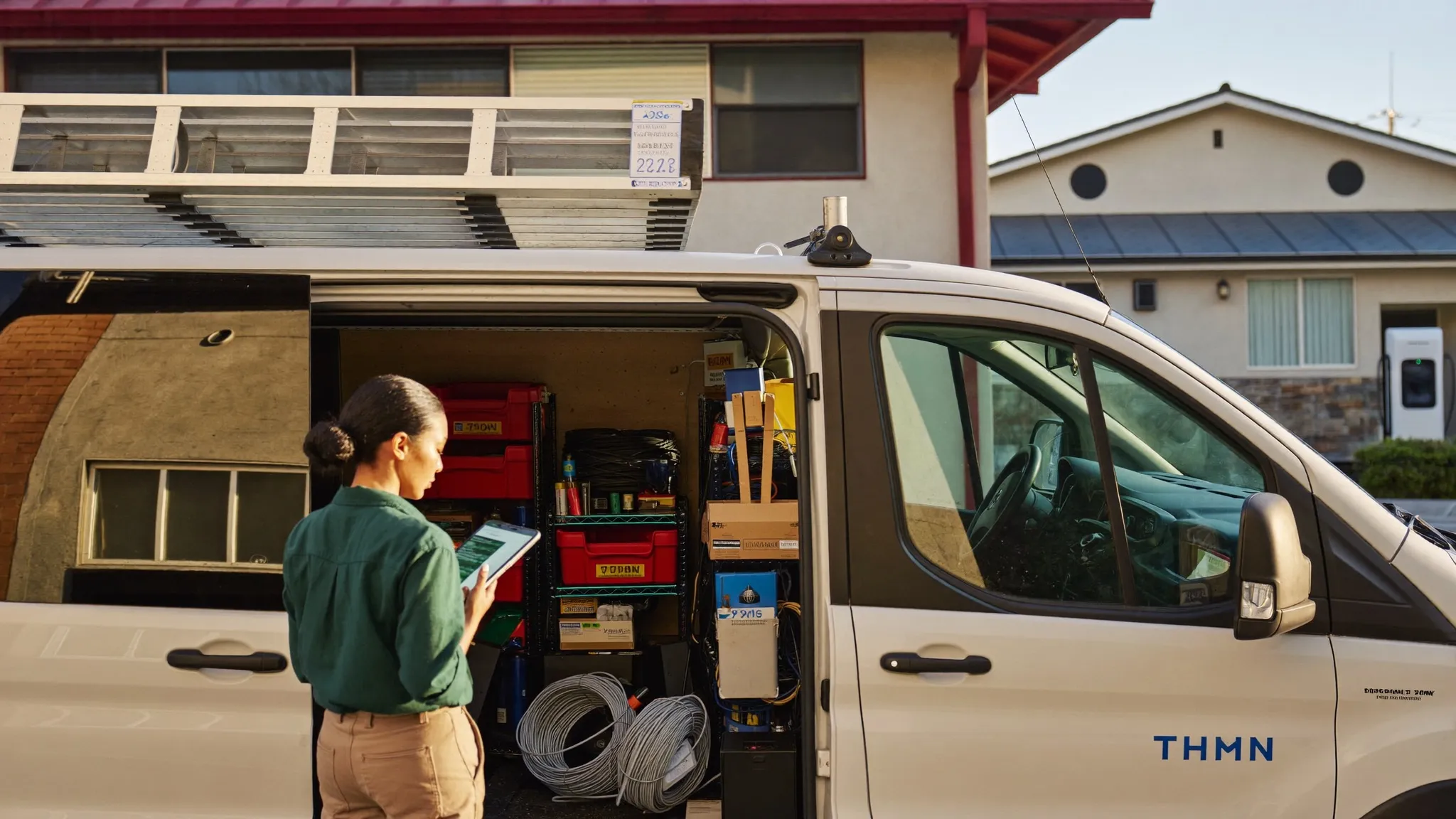
When Alicia Carter and Brandon Mills first crossed paths in 2022, it was on a hotel buildout in Sacramento — Alicia running conduit and panel work on the third floor, Brandon hanging ductwork two floors down. Both were five-plus years into journeyman cards. Both were making roughly the same hourly. Both were starting to think the same thing: how much of what they were building actually went to them.
They made the same decision a year apart. Alicia started her own business in February 2024. Brandon started his in October 2023. Today Alicia has four employees and a rolling commercial pipeline. Brandon is back at a larger company, subbing on jobs he used to bid, and re-saving for a relaunch he’s targeting for early 2027. Both of them, when we talked to them separately this spring, said the same thing about the leap: it wasn’t the work that was hard.
Alicia: the year she stopped waiting
Alicia’s story is the one that worked. She holds a California C-10 contractor’s license and an IBEW journeyman card, which is the credential combination that opens up commercial EV-charger work — and in early 2024 that work was a noticeable share of what was on bid lists in Northern California. Her former employer was passing on most of it because the company didn’t have the appetite to grow its commercial side. So she went on her own.
What she had at the start, in her own words: $34,000 in savings, a beat-up Tacoma she’d been driving for six years, and a verbal commitment from a small property-management company she’d done work for as a side job in 2023. What she didn’t have: a real work truck, the inventory of materials a commercial EV-charger job actually requires on day one, and a credit line. The Tacoma got her to the first three jobs but wasn’t going to carry conduit and a ladder rack for the fourth.
The financing piece is where most new owners get told no by the bank. Alicia did get told no — by her credit union, by two community banks, and by the SBA preferred lender her credit union referred her to. The decline reason was consistent: too new, no business credit history, no real estate collateral. What worked, eventually, was a specialist trade lender that funds new owners — a category of underwriter that reads license-gated work and a signed letter of intent from a commercial customer as the kind of revenue signal that generic small-business lending can’t price correctly. She got a working-capital line of $75,000 priced at 16% APR, and on the strength of that, she qualified for a separate equipment loan for a 2019 Ford Transit at 9.2% over 60 months.
The line let her stock material for the EV-charger jobs without floating it on a credit card. The Transit ended her ladder problem and turned the back of the van into the rolling toolbox she’d been doing without. Eighteen months in, she’s billed roughly $620,000, paid herself a defensible W-2 salary, and brought on two journeyman-level electricians plus an apprentice. License-backed business loans for electricians like the line she used are the part of the financing market most newly-solo electricians don’t know exists — Alicia certainly didn’t, until her third decline.
Brandon: the year the math turned
Brandon’s path was harder, and he doesn’t sugarcoat it. He launched his HVAC business in October 2023, with a wider customer base than Alicia had on day one — a year of side residential service calls, two repeat property managers, and what he assumed was a stable enough mix to underwrite a small line for equipment and parts inventory. The line he got, from a specialist HVAC lender, was $50,000 priced at 18% APR. It was enough capital, by his math at the time. It became not enough by the spring of 2024 for two reasons that both hit at the same time.
The first was the A2L refrigerant transition. Equipment he’d been quoting in fall 2023 was no longer the equipment he was actually buying by spring 2024. Compliant units cost more, his suppliers were short on inventory, and his refrigerant-handling certification needed an upgrade that was both a cash and a calendar hit. He’d modeled an 8% margin on his residential service calls. By April 2024 he was running closer to 3%.
The second was customer concentration. One of his two repeat property managers — about 40% of his billings — switched to a national maintenance contract in May 2024 and gave him 30 days’ notice. He’d had no contractual protection on that revenue, which he describes now as the single thing he’d undo if he could only undo one thing. The combination of the A2L margin compression and the property manager exit meant the line he’d sized in October 2023 ran out by June 2024. He drew on it, paid it back from the residential service work, and tried to grow into the gap. By August he was funding payroll on personal credit.
He shut the business down cleanly in November 2024. He went back to working for the larger HVAC contractor he’d left, with a clear understanding on both sides that this was a runway, not a return to permanence. He’s targeting early 2027 to relaunch. He says what he’d do differently isn’t about the loan itself: it’s about not signing a license credit line until he had 12 months of operating cash plus a non-property-management customer base. The next time, he says, he’ll size HVAC-specific business financing against actual three-month average billings, not bid-pipeline optimism.
What the math looked like for each of them
Alicia’s truck math is the cleanest example of how a payment looks different on paper than it does in monthly cash. The Transit she financed was $42,000 out the door. Over 60 months at 9.2%, that’s roughly $878 per month — money she could absorb against her billing rate. Over 48 months it would have been $1,047 per month, which she ran in a work-truck payment calculator before she signed and decided was more than her year-one cash could handle. She added a year of payments to gain $169 of monthly breathing room, and counts that decision as one of the three that made the business viable.
Brandon’s math was tighter. The 18% line he was paying was costing him roughly $750 a month at peak draw, on top of the equipment payments. When his margins compressed, the line went from a tool to a tax.
What each says now
Alicia, on the leap: “The thing I tell anyone thinking about going on their own is that you don’t get to start the business with the same balance sheet you had as an employee. You’re going to spend down the savings you thought were a cushion. The question is whether you set up the financing before you spend it down or after. It is so much easier before.”
Brandon, on the pullback: “I don’t think I made a bad decision. I think I made a decision with too narrow a margin for error. The work was always there. The thing that wasn’t there was the cushion. Next time, I’m going to wait until I can underwrite a soft year before the bank does.”
What this is actually about
The leap from journeyman to owner is sold, in trade culture, as a question of work ethic and resilience. Both of those things matter. But the part that decides whether a new-owner business stays in business in 2026 is mostly the financing scaffolding underneath it — when it’s sized, who underwrites it, how it’s matched to the actual revenue rhythm. Alicia and Brandon both made the leap. The difference between them is mostly about what they did, or didn’t do, with the math before they did the rest of the work.
We’ll be following both of them through the rest of 2026.
Editor’s note: Names changed and identifying details composited from multiple operator interviews to protect subjects’ commercial relationships. Rate ranges, financing structures, and the sequence of events reflect the actual experiences described.